Selecting a competent industrial automation company is a critical decision for any factory manager, operations director, or principal engineer. The integration of advanced machinery and sophisticated software directly impacts production efficiency, safety protocols, and long-term operational viability. A poorly executed automation project can result in persistent downtime, while a well-engineered system provides stability and measurable efficiency gains. This article provides a comprehensive guide to evaluating potential automation partners, focusing strictly on technical expertise, industry certifications, and proven experience across demanding industrial sectors.
We will examine the essential criteria for selecting a systems integrator. This ranges from their proficiency with major programmable logic controller platforms to their ability to execute precise control panel design. We will also explore the necessity of stringent quality standards and the value of specific industry experience.
Defining Your Factory Automation Requirements
Before approaching any external engineering firm, factory operators must clearly define their internal automation objectives. The requirements gathering phase forms the foundation of any successful engineering project. Factories require bespoke solutions, whether the objective is upgrading a legacy motor control centre, implementing a completely new automated production line, or simply improving data visibility across existing assets.
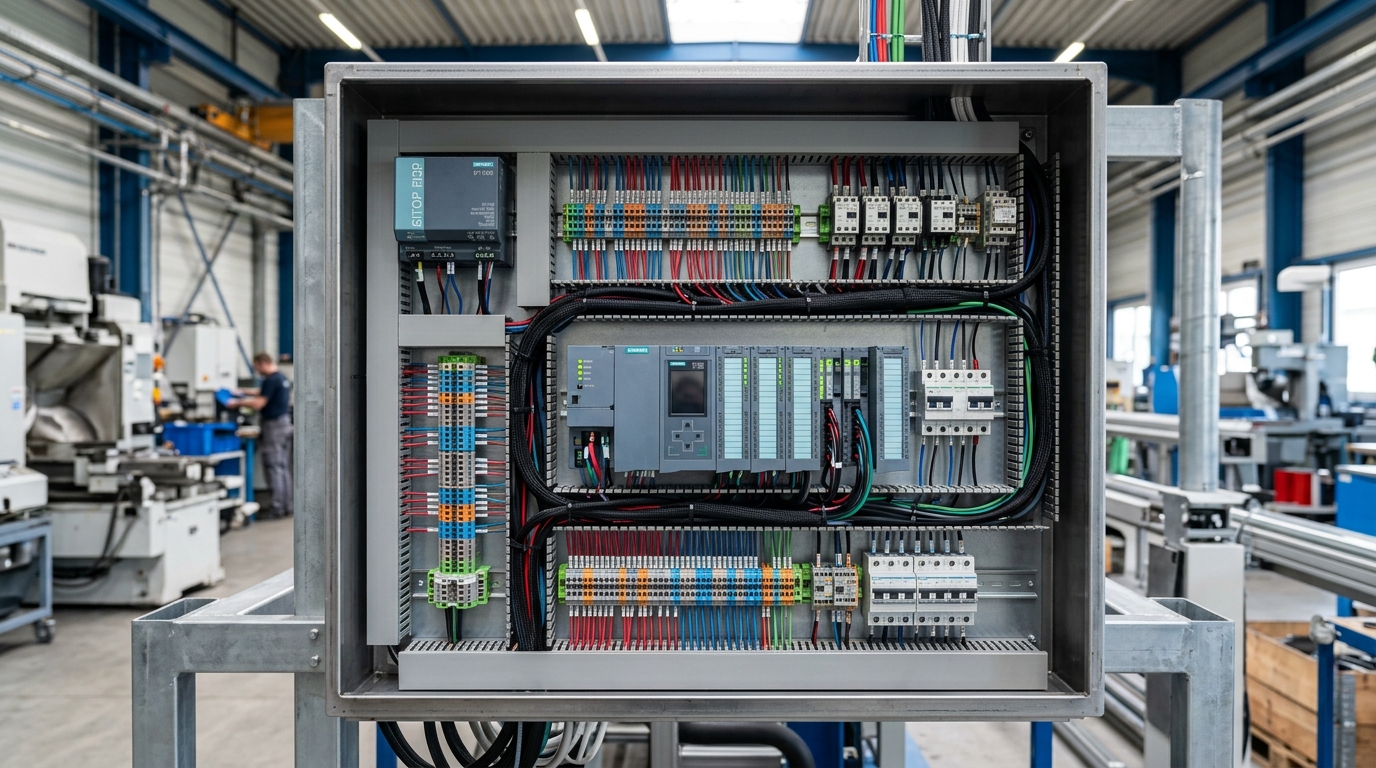
A central aspect of this definition phase is understanding the physical and environmental constraints of your facility. Control panel design, for instance, is highly dependent on the specific operational environment. Panels located in washdown areas of food and beverage manufacturing plants require high ingress protection ratings. Panels situated in explosive atmospheres necessitate specific ATEX-certified designs to prevent ignition. The automation company must demonstrate an immediate understanding of these environmental factors.
An effective industrial automation company will not simply accept a preliminary brief; they will interrogate it thoroughly. They should ask detailed technical questions regarding duty cycles, anticipated load variations, harmonic distortion, and future expansion plans. The goal is to design a system that accommodates present requirements while allowing for subsequent upgrades without requiring entirely new infrastructure. They should also seek to understand your existing electrical distribution system to ensure that any new control panels can be integrated safely and legally.
Furthermore, the initial planning stage must address the human element. Operators and maintenance personnel will interact with the new systems daily. The design must account for their specific workflow, ensuring that control interfaces are intuitive and that emergency stop procedures are easily accessible and compliant with safety directives. By defining these parameters early, you establish a clear baseline against which you can evaluate potential automation partners.
Assessing Technical Proficiency and Vendor Partnerships
The core of any modern automated system is its control architecture. Therefore, evaluating an automation company's technical capabilities is an absolute requirement. You must look beyond marketing material and assess their actual engineering output.
Programmable Logic Controllers
A proficient automation provider must demonstrate extensive experience programming and commissioning equipment from industry-leading manufacturers. Familiarity with a single brand is rarely sufficient in complex industrial environments. Integration with existing legacy systems is frequently required, meaning engineers must often bridge communication gaps between different generations of hardware.
Your chosen partner should possess deep technical knowledge of hardware from key vendors such as Siemens, Mitsubishi, Unitronics, and Allen Bradley. Each of these platforms possesses distinct programming environments and communication protocols.
Siemens is widely used across European manufacturing and process industries. It offers the TIA Portal environment, which integrates PLC programming with human-machine interface configuration. Expertise in Siemens systems indicates a capacity to handle large, complex network topologies.
Allen Bradley is often the standard in the Americas and requires expertise in RSLogix and Studio 5000. Many multinational corporations specify Allen Bradley hardware globally, requiring local integrators to be fully proficient in their use.
Mitsubishi provides highly reliable hardware often found in discrete manufacturing and high-speed packaging applications. Their GX Works programming software requires specific knowledge to optimise execution times.
Unitronics offers integrated PLC and HMI units that are highly effective for specific machine control applications where space is limited, but functionality cannot be compromised.
The ability to write clean, annotated, and logically structured code across these varied platforms is a strong indicator of engineering competence. Poorly structured code leads to significant delays during commissioning and introduces severe difficulties during future maintenance interventions. Ask potential partners for examples of their coding standards and request details on how they handle version control during large projects.
SCADA Systems and User Interfaces
Beyond the base-level programmable logic, operations managers require clear visibility into plant activities. This visibility is achieved through Supervisory Control and Data Acquisition (SCADA) systems and localised HMI panels.
An experienced industrial automation company will design HMI screens that present critical data logically. Operators must be able to identify fault conditions instantly. The graphical interface should prioritise clarity over unnecessary visual complexity. Alarm management is a critical sub-component here; systems must be designed to avoid alarm fatigue, ensuring that operators only receive alerts for genuinely critical conditions.
SCADA systems take this data aggregation further. They collect information across the entire factory floor to facilitate data-driven decision making. Integrating these systems requires strong networking knowledge, particularly concerning industrial Ethernet protocols like PROFINET, EtherNet/IP, and Modbus TCP. The automation company must understand how to segregate control networks from corporate IT networks to ensure deterministic performance and maintain cybersecurity.
Secure Remote Access
Modern factory management frequently demands secure remote access for diagnostics and maintenance. Implementing specific hardware solutions, such as EWON routers, allows engineers to connect to the factory network securely from off-site locations.
This capability drastically reduces operational downtime. Engineers can diagnose faults, monitor real-time variables, and push software updates without travelling to the facility. However, an automation partner must understand the severe cybersecurity implications of these remote connections. They must implement appropriate hardware firewalls, utilise strong encryption protocols, and ensure that remote access can be physically disabled by on-site personnel when not actively required.
The Importance of Stringent Quality and ISO Standards
Technical capability must be underpinned by rigorous quality management systems. When selecting an automation company, you must verify their adherence to internationally recognised standards. These certifications are not merely administrative requirements; they represent a fundamental commitment to engineering excellence, safety, and traceability.
ISO 9001 Quality Management
The primary certification to look for is ISO 9001. This standard relates directly to quality management systems. An ISO 9001 certified company operates with defined processes for design, manufacturing, testing, and documentation. This ensures consistency throughout the project lifecycle.
If a fault occurs in a control panel three years after installation, a company with strong ISO 9001 practices will be able to retrieve the original schematics, the exact bill of materials, and all associated test certificates immediately. This rapid retrieval of information is vital for fault-finding and minimises production losses. It also ensures that any replacement parts are specified correctly, matching the original design intent.
Specialised Inspection Accreditations
Beyond general quality management, specific inspection and testing accreditations provide further assurance of technical competence. ISO 17020 specifies requirements for the operation of various types of bodies performing inspection. This certification indicates that the company conducts inspections of its electrical installations and control systems with absolute impartiality and documented technical competence. It demonstrates that their internal checking mechanisms are robust enough to withstand independent scrutiny.
Similarly, ISO 17025 specifies the general requirements for the competence, impartiality, and consistent operation of laboratories. While often associated with formal calibration laboratories, an automation company holding or adhering to the core principles of ISO 17025 demonstrates a highly structured approach to testing. This means they validate their control systems systematically before the equipment ever reaches the factory floor, utilising calibrated test equipment and formalised factory acceptance testing procedures.
You can find more information about the specifics of these international standards directly on the official ISO website.
Reviewing Track Records Across Varied Industries
The final major factor in choosing an automation partner is reviewing their previous project experience. A company that has successfully delivered complex projects across highly regulated sectors is generally well-equipped to handle standard factory automation tasks. Diverse experience indicates adaptable engineering skills and a strong understanding of different regulatory frameworks.
Examine the company's client portfolio carefully. MASK Control Systems, for instance, has extensive experience delivering solutions for organisations with exceptionally high standards for reliability, precision, and safety.
Defence and Critical Infrastructure
Working with clients such as the UK MOD and Babcock requires adherence to strict security protocols and exacting engineering standards. Projects in these sectors often involve critical infrastructure where system failure is completely unacceptable. An automation company trusted by these organisations has proven its ability to design fail-safe systems. They have also demonstrated the capacity to produce the exhaustive documentation required for compliance in highly regulated environments. This level of discipline translates directly to higher quality outcomes in standard manufacturing facilities.
Aviation and Transport
The transport sector, including rail and commercial aviation, demands highly reliable control systems. Providing engineered solutions for Alstom, Emirates, and Etihad indicates a capacity to work within environments where precision and maximum uptime are paramount.
Baggage handling systems, facility environmental controls, and specialist maintenance equipment all rely on intricate PLC logic and robust control panel design. The ability to meet the stringent demands of international transport hubs is a strong positive indicator of an automation company's capability. These environments run continuously, and any automation system must be designed for maximum availability and rapid mean-time-to-repair.
Academic and Research Facilities
Research institutions frequently require bespoke, one-off control systems that do not fit standard industrial templates. Developing advanced systems for the University of Exeter, the University of Southampton, and the University of Warwick requires a highly flexible engineering approach.
These projects often involve integrating novel sensors, controlling precise environmental test chambers, or automating complex, high-speed experimental rigs. An automation company capable of adapting to these unique scientific challenges will bring significant problem-solving skills to any factory automation project. They understand how to process complex analogue signals and apply advanced PID control loops to achieve precise regulation.
Risk Management and Project Execution
Selecting an industrial automation company is also an exercise in risk management. Upgrading critical factory infrastructure carries inherent risks to ongoing production schedules. Therefore, you must evaluate how a potential partner plans, executes, and mitigates risks during a project.
Project Management Methodology
Enquire about their specific project management methodology. A professional automation company will assign a dedicated project manager who acts as a single point of contact. This manager should provide regular, detailed progress reports, updated Gantt charts, and clear communication regarding any technical challenges encountered during the design phase.
Factory Acceptance Testing (FAT)
A critical phase of risk mitigation is the Factory Acceptance Test. This takes place at the automation company's facility before the equipment is shipped to your site. During the FAT, the control panels are powered, and the PLC logic is tested using simulated inputs and outputs.
You should expect the automation company to provide a comprehensive FAT document, detailing every test required to prove the system meets the functional design specification. A thorough FAT drastically reduces the time required for on-site commissioning and identifies software bugs in a controlled environment where they can be rectified quickly. If a company attempts to rush or skip the FAT phase, it is a significant warning sign regarding their overall quality commitment.
Site Acceptance Testing (SAT) and Commissioning
Following installation at your factory, the final phase is the Site Acceptance Test and formal commissioning. The automation company must provide engineers who understand the mechanical realities of the machinery they are controlling, not just the software logic. They must work methodically through the SAT document, proving that the entire system operates safely under real-world load conditions. They should also coordinate effectively with your mechanical contractors and electrical installation teams to ensure a smooth handover.
A Framework for Decision Making
To systematise the selection process and ensure all critical factors are evaluated objectively, consider using the following structured criteria when comparing potential industrial automation companies:
- Detailed Needs Analysis Phase: Does the company spend adequate time understanding the specific operational requirements, or do they immediately propose a generic, off-the-shelf solution?
- Multi-Vendor Platform Expertise: Can they demonstrate high-level proficiency with the specific hardware currently installed in your facility, such as Siemens, Mitsubishi, Unitronics, or Allen Bradley?
- In-House Control Panel Manufacturing: Do they design and build control panels in-house, ensuring tight quality control, or is this critical function outsourced to third parties?
- SCADA and HMI Capabilities: Can they provide concrete evidence of creating clear, functional operator interfaces and implementing secure remote access solutions like EWON?
- Certified Quality Systems: Are they certified to ISO 9001, and do their internal inspection processes align with ISO 17020 and ISO 17025 principles?
- Regulated Industry Experience: Have they successfully delivered complex projects for high-demand clients such as the UK MOD, Alstom, or major research universities?
- Comprehensive Documentation Practices: Do they guarantee the provision of full electrical schematics, annotated PLC source code, and comprehensive operating manuals upon project completion?
- Long-Term Support Agreements: Do they offer structured maintenance contracts to ensure continued system reliability after the initial commissioning phase is complete?
- Rigorous Testing Protocols: Do they enforce strict Factory Acceptance Testing and Site Acceptance Testing procedures to mitigate project risk?
Selecting the Right Partner for Long-Term Success
Choosing the correct industrial automation company requires meticulous evaluation and a clear understanding of your own operational needs. The selected partner will be responsible for designing and maintaining systems that dictate the overall productivity and safety of your manufacturing operations for the next decade.
By focusing heavily on their technical proficiency across major platforms like Siemens and Allen Bradley, verifying their commitment to quality through recognised ISO certifications, and reviewing their track record with demanding clients, factory managers can make an informed, data-driven decision. Do not compromise on technical competence or documentation standards, as these factors directly influence the total cost of ownership over the lifespan of the equipment.
The ultimate objective is to establish a long-term engineering partnership. The right automation company will not only deliver the immediate project to specification but will also provide the ongoing support, reactive maintenance, and technical insight required to keep your factory operating at peak efficiency for years to come.
For more details on how we approach these complex engineering challenges and mitigate project risks, you can review our control panel design services and our comprehensive PLC programming capabilities. If you require specific details regarding remote access and data aggregation, please see our detailed information on secure SCADA integration. Our team is prepared to review your specific factory requirements and propose a robust, technically sound solution.