Understanding the financial investment required for an industrial control system is a primary concern for engineering managers, operations directors, and procurement teams across the United Kingdom. As we progress through 2026, the variables influencing the price of these vital assets continue to fluctuate based on global supply chains, component availability, technological advancements, and the specific demands of highly regulated industries. A custom control panel is strictly not a commodity product. It is a highly specialised, meticulously engineered solution designed to meet exacting operational criteria and safety standards. Attempting to assign a single, universal price to a bespoke system is entirely impractical because the final cost depends completely on the unique requirements of the specific application it is designed to manage.
The primary purpose of this detailed guide is to provide a comprehensive, technical analysis of the elements that dictate pricing in the current market. We will methodically examine every aspect of the manufacturing process, from the initial conceptualisation and complex control panel design through to the selection of premium internal components, rigorous factory testing, and final site commissioning. By breaking down the contributing financial factors, we aim to offer absolute clarity for those tasked with budgeting for complex automation projects in demanding sectors such as defence, aerospace, heavy manufacturing, marine operations, and critical national infrastructure.
Investing in a meticulously designed and professionally manufactured control panel yields substantial long term dividends through significantly reduced mechanical downtime, increased operational efficiency, and vitally enhanced personnel safety. A precise, technical understanding of the underlying costs allows organisations to make informed, strategic decisions that align perfectly with their long term operational objectives and immediate financial constraints. This document serves as a detailed, technical roadmap to the financial considerations inherent in modern industrial automation.
Core Components: The Foundation of Reliable Control
The most significant and highly variable element in the overall cost of a custom control panel is the selection of its internal components. The specific brand, product series, and processing capability of the Programmable Logic Controller (PLC), heavy duty switchgear, safety relays, and associated power electronics directly correlate with the final financial outlay. We consistently recommend specifying and utilising established, tier one European or global manufacturers to ensure absolute longevity, parts availability, and unwavering reliability in highly demanding operational environments.
Programmable Logic Controllers (PLCs)
The PLC acts as the central processing unit and the fundamental brain of the entire control panel. The selection of the correct PLC must be strictly dictated by the specific technical requirements of the industrial process it is controlling. This includes precisely calculating the necessary number of digital and analogue input and output (I/O) points, required processing speed for rapid machine operations, internal memory capacity for complex programming logic, and the necessary industrial communication protocols required to interface with third party equipment.
Industrial systems requiring fundamental logic control for a limited number of field devices can often be satisfied by entry level PLCs. However, complex, high speed manufacturing processes or critical infrastructure applications demand advanced processing capabilities, redundant processor architecture, and extensive, distributed I/O capacity.
- Siemens: A completely dominant force in the European automation market. The Siemens SIMATIC S7-1200 series provides a highly capable, cost efficient solution for compact applications, offering excellent technical value. For highly demanding, complex automation tasks requiring motion control or extensive data handling, the premium S7-1500 series is almost universally the specified choice. This platform commands a significantly higher price due to its advanced processing power, integrated safety features, and sophisticated PROFINET communication capabilities.
- Allen Bradley: Frequently specified within the UK for applications where strict compatibility with existing North American systems is required or corporately preferred. The Micro800 series caters efficiently to smaller, standalone applications. Conversely, the CompactLogix and fully redundant ControlLogix platforms represent a major capital investment designed for large scale, high performance continuous process systems.
- Mitsubishi: Globally renowned for providing exceptional hardware reliability and incredibly rapid processing speeds. The MELSEC iQ-F series is a highly versatile option for standalone packaging or processing machines, whereas the advanced iQ-R series provides a premium, infinitely scalable solution for extensive automotive or heavy industrial production lines.
- Unitronics: An excellent, highly specialised option for specific applications where an integrated PLC and Human Machine Interface (HMI) in a single physical unit is highly advantageous. These combined units can offer notable cost savings by significantly reducing internal wiring complexity and reducing overall software programming time for suitable, less complex projects.
Switchgear, Relays, and Power Supplies
Moving beyond the central PLC, the precise specification of switchgear, heavy duty contactors, safety relays, and industrial power supplies significantly impacts both the initial cost and the long term reliability of the system. Specifying premium brands for these specific components is absolutely essential to prevent premature mechanical or electrical failure and ensure complete operational safety.
Motor contactors designed specifically for frequent, rapid switching under heavy inductive loads are inherently more expensive than standard resistive load variants. Similarly, specifying 24V DC power supplies with built-in redundancy features, intelligent load balancing, or advanced network diagnostics adds directly to the initial capital investment but provides critical, non-negotiable protection for highly sensitive and expensive PLC electronics. The cost variation between standard industrial components intended for a clean factory floor and those heavily rated for specific extreme environments, such as marine applications demanding corrosion resistance or ATEX rated explosive atmospheres, is exceptionally substantial.
Control Panel Design and Engineering Expertise
The intellectual property, technical experience, and pure engineering hours invested in the control panel design phase constitute a critical, foundational component of the overall project cost. A control panel is fundamentally only as effective and reliable as the engineering logic behind its creation. This phase is not merely about drawing a basic electrical schematic. It is an intensely rigorous technical process of ensuring electrical safety, operational functionality, thermal stability, and strict compliance with all relevant European and UK directives.
Conceptualisation and Specification
Before any physical metalwork or assembly begins, highly comprehensive engineering drawings must be generated by qualified electrical design engineers. This complex process involves drafting detailed, multi-page electrical schematics, creating precise general arrangement drawings indicating optimal component layout for heat dissipation and cable routing, and compiling extensive, highly accurate bill of materials (BOM) documentation for the procurement team.
The financial cost and time required for this vital phase is directly proportional to the functional complexity of the required system. A relatively simple direct-on-line (DOL) motor starter panel requires a small fraction of the engineering design time needed for a comprehensive, multi-zone process control system integrating multiple variable frequency drives (VFDs), dedicated safety PLCs, and complex, multi-node industrial communication networks.
Environmental and Thermal Considerations
A highly critical, yet frequently underestimated aspect of professional control panel design is comprehensive thermal management. Modern electronic components, particularly large variable speed drives, transformers, and heavy duty power supplies, generate highly significant amounts of heat during normal operation.
Professional design engineers must accurately calculate the total heat dissipation of all internal components operating simultaneously under maximum load. Following these calculations, they must design and specify an appropriate cooling strategy to strictly prevent internal overheating, which directly causes erratic PLC behaviour and premature component failure. This strategy may involve simple passive ventilation louvres, forced air cooling utilising heavily filtered industrial fans, or, in extreme ambient temperature environments, active thermoelectric cooling or dedicated air conditioning units mounted directly to the steel enclosure. The highly skilled engineering time required to perform these complex thermodynamic calculations and the physical cost of the climate control hardware itself contribute substantially to the final quoted price.
Programming and Software Development
For any system incorporating a PLC, the methodical development of the control logic is a very significant engineering undertaking. The financial cost of this software programming is entirely dependent on the specific complexity of the industrial process, the exact number of distinct sequential operations required, the necessity for complex PID loop control, and the required level of fault diagnostics expected by the end user or maintenance team.
Writing highly clean, well structured, heavily annotated, and thoroughly documented software code is absolutely essential for reliable operation and future fault troubleshooting. This highly specialised task requires highly skilled software engineers possessing a deep, practical understanding of complex industrial processes and machinery safety standards.
Enclosures: Physical Protection in Demanding Environments
The physical steel or plastic enclosure serves as the absolute first line of physical defence for the highly sensitive and expensive electronic components housed within. The financial cost of the enclosure is dictated strictly by its physical dimensions, the specified material of construction, and the legally required ingress protection (IP) rating.
Material Selection
The specific operating environment where the custom control panel will be permanently installed dictates the mandatory material specification.
- Mild Steel: This remains the standard, highly cost effective choice for general industrial manufacturing environments. Mild steel enclosures, typically finished with a highly durable, baked powder coat paint finish, offer excellent mechanical protection and structural rigidity for the vast majority of dry, indoor applications.
- Stainless Steel (304 or 316 Grade): The specification of stainless steel is strictly mandatory for specific applications involving frequent high pressure washdowns, routine exposure to highly corrosive chemicals, or installation in harsh marine environments. Stainless steel 316 provides absolutely superior corrosion resistance compared to grade 304, but significantly increases the base cost of the enclosure. This premium material is very frequently specified and legally required in the food and beverage manufacturing, pharmaceutical production, and heavy water treatment sectors.
- Polycarbonate or GRP (Glass Reinforced Plastic): These materials are exclusively utilised in specific operational environments where non-metallic physical properties are strictly required. Examples include applications with very high exposure to certain highly corrosive acidic chemicals, or specific installations where total electrical isolation from the surrounding structure is a primary safety concern.
Ingress Protection (IP) Ratings
The technically required IP rating directly and significantly influences the final enclosure cost. A standard IP54 rating, offering adequate protection against settled dust and light splashing water, is perfectly suitable for many clean factory environments. However, demanding applications requiring IP65 (total protection against dust ingress and low pressure water jets) or IP66 (protection against heavy seas or powerful, directed water jets) necessitate custom enclosures with highly enhanced, continuous polyurethane sealing mechanisms, specialized heavy duty cable glands, and significantly reinforced door construction. These technical requirements lead directly to increased manufacturing costs. Furthermore, custom enclosures designed specifically to fit extremely tight spatial constraints or requiring non-standard laser cutouts for specific HMIs, pushbuttons, and panel meters also inherently attract a significant premium over standard, off the shelf enclosure sizes.
Software Integration: SCADA, HMI, and Secure Remote Access
Modern industrial manufacturing and infrastructure systems very rarely operate in complete isolation. The technical ability for operators and managers to precisely monitor, manually control, and continuously extract production data from the control panel is absolutely essential for maximising operational efficiency. The integration of these advanced software interfaces significantly impacts the total initial investment.
Human Machine Interfaces (HMI)
An industrial HMI provides the local machine operator with a highly visual, graphical representation of the physical process and the necessary means to interact directly with the control system. The cost of specifying an HMI varies drastically based on the physical screen size, display resolution, internal processing power, and the specific environmental IP rating of the front bezel.
A basic, monochromatic text display is significantly less expensive than a large, high resolution, multi-touch colour screen featuring highly advanced graphical rendering, complex alarm management, and historical data logging capabilities. We regularly integrate premium HMIs from leading manufacturers to ensure highly reliable, responsive operator interaction in demanding conditions.
Supervisory Control and Data Acquisition (SCADA)
For very large scale industrial operations requiring the centralised, continuous monitoring and control of multiple disparate control systems across a large site, a comprehensive SCADA system must be implemented. Professional SCADA integration involves highly significant software development time. This includes configuring complex SQL databases, creating highly detailed and intuitive graphical interfaces across multiple monitors, and establishing highly secure, redundant communication networks using fibre optics or industrial Ethernet.
The software licensing costs alone for premium SCADA platforms can be highly substantial, and the dedicated engineering time required to properly develop, test, and implement a robust, fault tolerant system represents a major, unavoidable portion of the overall project budget.
Remote Access and Diagnostics (EWON)
The technical ability to highly securely access a control panel remotely via the internet is increasingly demanded by modern industrial operators and maintenance managers. Implementing highly secure, dedicated industrial VPN routers, such as those provided by EWON, allows authorised engineers to continuously monitor system performance, perform highly detailed remote diagnostics, and even update complex PLC logic without ever being physically present on the factory site.
While the specialised routing hardware and the ongoing secure VPN cloud services add directly to the initial capital cost, the highly significant long term financial savings achieved through drastically reduced emergency maintenance visits, minimised production downtime, and rapid fault resolution almost universally justify the initial financial investment.
Quality Assurance, Standards, and Certification
A defining, non-negotiable characteristic of a professional, highly reputable control panel builder is their strict adherence to stringent international quality standards. This unwavering commitment to engineering excellence ensures the final physical product is completely safe, highly reliable, and fully compliant with all relevant UK and European statutory regulations. Maintaining these high standards requires highly significant, ongoing financial investment in internal processes, staff training, and calibrated testing equipment, which is naturally reflected in the final project cost.
ISO Certification and Quality Management
Working in partnership with a control panel manufacturer that currently holds recognised ISO certifications (governed by the International Organization for Standardization) provides absolute assurance of a highly mature, strictly controlled, and fully audited manufacturing process.
- ISO 9001: This fundamental quality management standard ensures that the manufacturing company has highly robust, documented processes firmly in place for every single stage of a project. This covers everything from the initial technical enquiry and component procurement through to final physical delivery and ongoing technical support. It legally guarantees complete traceability of all internal components and a demonstrable commitment to continuous organisational improvement.
- ISO 17020 and ISO 17025: For very specific, highly regulated sectors, particularly those involving critical measurements, calibration, or formal inspections, strict adherence to these advanced standards may be legally required. They clearly demonstrate a highly advanced level of technical competence in specific testing and precise calibration procedures.
Continuously maintaining these vital certifications involves regular, highly detailed independent external audits and continuous, rigorous internal management reviews. This represents a highly significant financial overhead for the manufacturer, which directly contributes to the overall, sustainable pricing structure of their engineering services.
Rigorous Testing and Verification Procedures
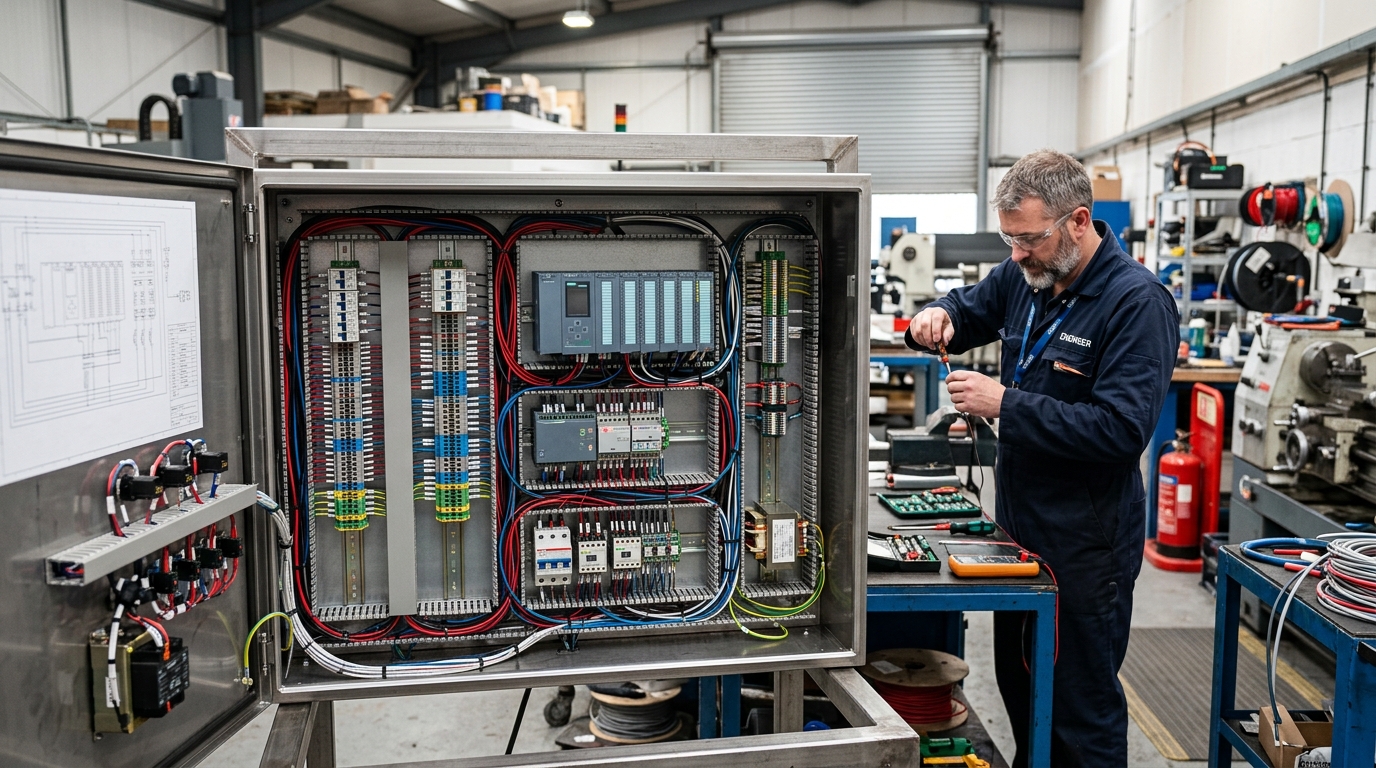
Absolutely every custom control panel manufactured must undergo exhaustive, highly documented testing prior to physical dispatch from the factory. This process is strictly not a cursory visual check. It involves highly comprehensive, methodical point-to-point electrical wiring verification using calibrated multimeters to ensure every single physical connection matches the approved electrical schematic perfectly.
Following this cold testing, the panel is fully powered up using dedicated test supplies, and comprehensive functional testing is meticulously conducted to verify the precise operation of all internal components, the safety relay circuits, and the full sequence of the programmed PLC logic.
A highly thorough Factory Acceptance Test (FAT), very often conducted in the physical presence of the end client or their designated engineering representative, is the absolute final stage of formal verification before the heavy panel leaves the manufacturing facility. The highly skilled engineering time dedicated to these rigorous, necessary testing procedures is a vital, non-negotiable investment in ensuring the completed system functions flawlessly immediately upon site installation.
Site Installation, Commissioning, and Ongoing Support
The financial and operational commitment of a professional integration project extends far beyond the mere physical delivery of the metal control panel. Proper, technically compliant electrical installation and expert commissioning are absolutely critical to the ultimate success of the automation project.
Site Installation and Cabling
The financial cost of physical installation depends heavily on the geographic location of the site, the specific complexity of the required mechanical integration with existing heavy machinery, and the required complexity of the heavy cable routing on containment systems. Electrical installations in highly hazardous ATEX areas or heavily restricted environments, such as active marine vessels or secure, active defence facilities, require highly specialised personnel training, extensive risk assessment documentation, and strict adherence to specific site safety procedures, all of which substantially increase the overall project cost.
Commissioning and Process Optimization
Site commissioning involves physically integrating the new control panel into the wider industrial process and formally verifying that the entire electro-mechanical system operates exactly as intended under demanding, real world production conditions. This highly critical phase very often requires meticulous fine tuning of complex PLC logic, precise calibration of analogue field sensors, and absolute verification of all hardwired safety interlocks and emergency stop circuits. Highly experienced, senior automation engineers are strictly required to systematically and safely bring the complex system fully online and rapidly resolve any unforeseen, complex integration challenges that arise.
Training and As-Built Documentation
Providing highly comprehensive, tailored training for the site machine operators and the dedicated maintenance personnel is absolutely essential for long term success. Furthermore, clear, highly accurate, and extremely detailed technical documentation must be formally supplied. This strictly includes the final, updated "as-built" electrical schematics, comprehensive system operation manuals, detailed component datasheets, and secure, verified software backups of the PLC and HMI programs. The dedicated time required for the generation of this vital documentation and the provision of professional, on-site training are absolutely vital components of a complete, professional engineering service package.
Cost Breakdown: 2026 Projections and Estimates
Providing a perfectly definitive, universal price list for highly custom engineering systems is practically impossible. However, based closely on current industrial market trends, raw material pricing, and electronic component costs within the UK for 2026, we can confidently outline expected financial ranges for different broad categories of industrial control panels.
Expected Price Ranges
The following detailed comparison table provides an illustrative, general guide to expected capital costs. These figures are broad estimates and will naturally vary highly significantly based directly on the highly specific technical requirements outlined extensively in the previous sections of this guide.
| System Complexity | Typical Industrial Application Example | Estimated Cost Range (UK £) | Primary Financial Cost Drivers |
|---|---|---|---|
| Basic Control Systems | Simple water pump station, single large motor control, basic logic relay system. | £2,500 - £8,000 | Physical enclosure size, basic standard switchgear, standard copper wiring. |
| Intermediate Automation | Standalone packaging machine control, small factory conveyor system, basic PLC and small touchscreen HMI. | £8,000 - £25,000 | Mid-range processing PLC (e.g., Siemens S7-1200), Variable Frequency Drives (VFDs), basic HMI software programming, standard mild steel enclosure. |
| Advanced Process Control | Complex chemical manufacturing line, precision dosing system, advanced rapid PLC, hardwired safety integration, industrial network communication. | £25,000 - £75,000 | High-end processing PLC (e.g., Allen Bradley ControlLogix, Siemens S7-1500), highly complex software logic, extensive distributed I/O, premium enclosure (e.g., Stainless Steel 316). |
| Comprehensive Systems | Facility-wide full SCADA integration, critical national infrastructure control, highly regulated environments (defence, aerospace). | £75,000+ | Extensive, multi-disciplinary engineering design, highly complex software development, highly specialised military-grade components, extremely rigorous certification and FAT testing, strict active environmental controls. |
The Undeniable Value of Technical Expertise
When formally evaluating the quoted cost of a custom control panel, it is absolutely imperative for procurement teams to look far beyond the initial, upfront capital expenditure. Actively specifying substandard, unproven electronic components or utilising highly inexperienced, uncertified manufacturers simply to reduce upfront project costs invariably and predictably leads to highly significant financial losses over the operational life of the expensive equipment.
A sudden failure in a critical industrial control system results in immediate, highly costly production downtime. The severe financial impact of lost manufacturing production, fundamentally compromised product quality, and the necessity for emergency, out-of-hours engineering interventions very rapidly eclipses any perceived initial savings generated from a cheaper initial purchase price. Conversely, a meticulously engineered, professionally manufactured control panel, built exclusively with premium components and subjected to rigorous, documented testing, strictly ensures long term operational stability, safety, and ultimate financial longevity.
MASK Control Systems: Your Partner in Engineering Excellence
At MASK Control Systems, we proudly provide absolutely uncompromising, highly advanced engineering solutions for the most technically demanding industrial applications across the UK. Our rigorous approach to professional control panel design and physical manufacture is firmly founded on absolute technical excellence, extremely rigorous internal quality control, and a very deep, practical understanding of complex industrial automation.
We strictly do not provide generic, off-the-shelf solutions. Every single engineering project begins with a highly detailed, comprehensive technical consultation to precisely and accurately define the exact operational requirements, the specific environmental constraints, and the mandatory regulatory compliance standards. Following this, our dedicated team of highly experienced electrical design engineers and software programmers develops a completely bespoke, highly optimised solution that absolutely maximises system performance and long term reliability.
Trusted by Global Industry Leaders
Our unwavering commitment to engineering integrity and safety is clearly demonstrated by our extensive portfolio of long term clients operating in critical sectors where system failure is absolutely not an option. We have successfully designed, manufactured, and delivered highly complex control systems for major organisations including:
- Alstom: Providing highly critical, failsafe control infrastructure for the international rail sector.
- Babcock: Delivering extremely reliable, highly robust systems for critical defence and secure nuclear applications.
- Emirates and Etihad: Supplying highly robust, continuous operation control solutions for critical aviation support infrastructure.
- UK MOD (Ministry of Defence): Strictly meeting the extremely exacting, uncompromising standards legally required for secure military applications.
- University of Exeter, University of Southampton, and University of Warwick: Developing highly advanced, precision control systems for complex, cutting edge research and development facilities.
Our proven ability to consistently and reliably meet the extremely rigorous technical specifications demanded by these highly respected organisations is a clear testament to our advanced engineering capability and our very strict adherence to uncompromising quality standards, strictly including our formally audited and ISO 9001 certified manufacturing process.
Final Technical Summary
The true financial cost of a custom control panel in the UK for 2026 is a very direct, unavoidable reflection of the required engineering expertise, the specific premium component quality, and the highly rigorous testing procedures legally required to deliver a safe, reliable industrial solution. By thoroughly understanding the complex technical factors detailed extensively in this engineering guide—from the highly specific selection of advanced PLCs like Siemens and Allen Bradley to the absolute necessity of comprehensive, thermal control panel design and strict, uncompromising ISO compliance—organisations can make highly informed, strategic procurement decisions.
Investing wisely in a professionally engineered, meticulously tested system from a highly reputable, established UK manufacturer guarantees long term operational stability, strict personnel safety, and maximum production efficiency. We highly encourage you to contact our senior engineering team directly to discuss your highly specific project requirements and immediately receive a detailed, technically accurate, and fully comprehensive assessment for your next critical automation project. You can also thoroughly explore our extensive range of custom control panel services online to fully understand precisely how our engineering expertise can directly support your critical operational objectives.