
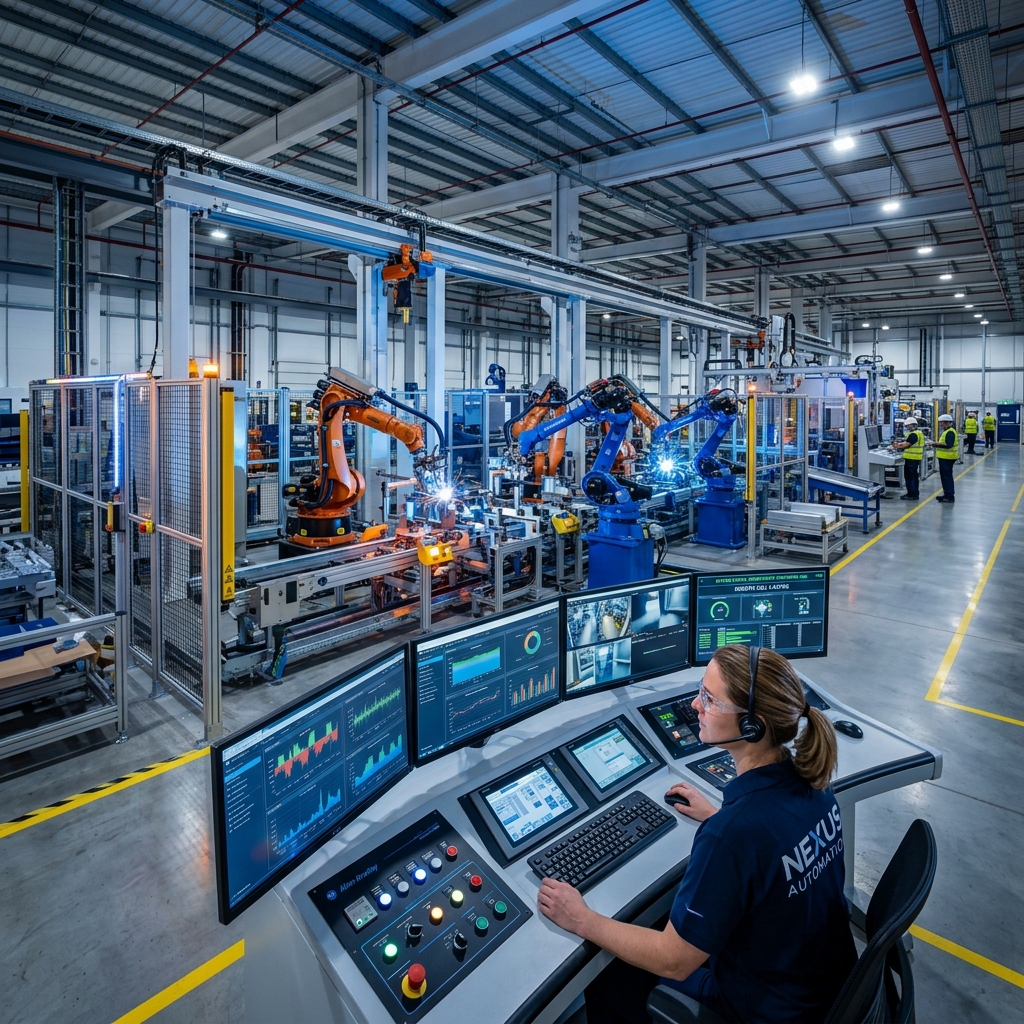
The landscape of global manufacturing and building management is undergoing a radical transformation. As industries strive for unprecedented levels of efficiency and sustainability, the reliance on sophisticated control systems has never been greater. At the heart of this revolution lie Programmable Logic Controllers (PLCs) and Building Management Systems (BMS). These technologies are not just keeping the lights on; they are fundamentally rewriting the rules of industrial operation across the globe, from the historic manufacturing hubs of the United Kingdom to the rapidly expanding, hyper modern infrastructures of the United Arab Emirates.
In my years of experience directing MASK Control Systems Limited, I have witnessed firsthand how the transition from manual, reactive processes to automated, predictive ecosystems can save companies millions. This evolution is driven by relentless innovation in hardware and software, shifting regulatory landscapes, and an urgent global mandate to reduce carbon footprints. In this article, we will explore the trajectory of these technologies, diving deep into PLC programming advancements, the critical role of BMS in modern facilities, and how industry giants like Siemens are shaping the future.
The Evolution of PLC Programming
Programmable Logic Controllers have been the reliable workhorses of industrial automation for decades. Originally designed to replace complex, error prone relay logic systems in the automotive industry, PLCs have evolved into incredibly powerful, compact computers capable of processing massive amounts of data in real time. The core function remains the same: monitor inputs from sensors, execute a user defined program, and control outputs like motors and valves. However, the complexity and capability of modern PLC programming have expanded exponentially.
Today, PLC programming is no longer just about ladder logic. While ladder logic remains incredibly popular due to its visual resemblance to electrical relay circuits, modern engineers frequently utilize structured text, function block diagrams, and sequential function charts. This shift allows for the development of highly complex algorithms necessary for advanced process control and robotics integration. The ability to write modular, reusable code has significantly reduced development time and improved software reliability across large scale manufacturing plants.
Furthermore, the integration of PLCs with the Industrial Internet of Things (IIoT) has transformed them from isolated controllers into connected edge devices. Modern PLCs can push data directly to cloud platforms for advanced analytics, machine learning, and predictive maintenance. This connectivity ensures that plant managers can monitor equipment health from anywhere in the world, addressing minor anomalies before they escalate into catastrophic mechanical failures.
Why Siemens Automation Leads the Charge
When discussing the future of PLC programming, it is impossible to ignore the influence of Siemens. Siemens automation platforms, particularly the SIMATIC S7 series and the TIA (Totally Integrated Automation) Portal, represent the gold standard in the industry. The strength of the Siemens ecosystem lies in its seamless integration. TIA Portal allows engineers to program PLCs, configure Human Machine Interfaces (HMIs), and set up variable frequency drives all within a single software environment.
This level of integration drastically reduces commissioning time and minimizes the risk of communication errors between different components. In highly demanding sectors such as oil and gas, food and beverage, and marine engineering, the robustness of Siemens hardware combined with the advanced diagnostic capabilities of TIA Portal ensures maximum uptime. As automation systems become more complex, relying on a unified platform like Siemens provides a significant competitive advantage for both system integrators and end users.
The Rising Criticality of BMS Systems
While PLCs dominate the factory floor, Building Management Systems (BMS) are the silent brains operating our commercial and industrial facilities. A BMS is a computer based control system installed within a building that oversees and regulates the building's mechanical and electrical equipment. This includes ventilation, lighting, power systems, fire alarms, and security systems. In the past, these systems operated independently. Today, a modern BMS integrates them into a single, cohesive network.
The primary driver behind the rapid advancement of BMS technology is energy efficiency. Commercial buildings consume a massive portion of global energy. An intelligent BMS can optimize heating, ventilation, and air conditioning (HVAC) systems based on real time occupancy data, external weather conditions, and energy pricing. By ensuring that energy is only used when and where it is needed, a well programmed BMS can reduce a facility's energy consumption by up to thirty percent.
Moreover, the line between traditional industrial automation (PLCs) and building automation (BMS) is blurring. In large scale manufacturing facilities and data centers, the environmental control provided by the BMS is just as critical to the production process as the machinery on the floor. Tight integration between the factory PLCs and the facility BMS allows for holistic energy management and unprecedented operational visibility.
Regional Perspectives: The UK vs. The UAE
Operating MASK Control Systems in both the United Kingdom and the United Arab Emirates provides a unique vantage point on global automation trends. While the underlying technology is the same, the application and driving factors differ significantly between these two regions.
In the United Kingdom, the focus is heavily geared toward retrofitting and modernization. The UK has a rich industrial heritage, which means many operational factories rely on legacy equipment. The challenge for automation engineers in the UK is integrating modern PLCs and IoT sensors into older machinery to extract data and improve efficiency without the prohibitive cost of replacing the entire production line. Additionally, the UK is bound by strict environmental and safety regulations, requiring automation systems to prioritize compliance, energy monitoring, and worker safety above all else.
Conversely, the United Arab Emirates is a landscape characterized by rapid growth and Greenfield projects. In the UAE and the broader GCC region, automation is often built into the foundation of new, hyper modern facilities. There is a massive emphasis on smart city integration, district cooling optimization, and large scale infrastructure projects. In the UAE, BMS systems are pushed to their limits to manage extreme environmental conditions, ensuring that massive commercial and industrial spaces remain perfectly climate controlled while minimizing energy waste. The adoption rate of cutting edge technologies, such as AI driven predictive maintenance, is exceptionally high in this region.
The Role of Predictive Maintenance
One of the most exciting developments resulting from modern PLC and BMS integration is the shift from reactive to predictive maintenance. Historically, equipment was run until it broke, or it was serviced on a strict calendar schedule regardless of its actual condition. Both approaches are inefficient and costly. Reactive maintenance leads to unplanned downtime, while strict schedule based maintenance often results in replacing parts that still have plenty of life left.
Predictive maintenance changes the paradigm. By utilizing sensors to monitor variables such as vibration, temperature, and current draw in real time, modern control systems can establish a baseline of normal operation. When a machine deviates from this baseline, the system can flag it for inspection long before a critical failure occurs. For example, a slight increase in the vibration of a motor bearing, detected by a PLC and analyzed by an edge computing device, can trigger an alert for a technician to replace the bearing during scheduled downtime. This prevents a catastrophic failure that could halt the entire production line for days.
Cybersecurity in Industrial Control Systems
As industrial automation systems become increasingly connected to enterprise networks and the internet, cybersecurity has emerged as a paramount concern. In the past, PLCs and BMS networks were "air gapped", meaning they had no physical connection to external networks. Today, the demand for remote monitoring and cloud analytics has eliminated the air gap, exposing critical infrastructure to potential cyber threats.
Securing modern automation systems requires a defense in depth strategy. This involves implementing robust firewalls, network segmentation, secure remote access protocols (like VPNs), and continuous monitoring for anomalous network traffic. Engineers must now consider cybersecurity at the design phase of a project, rather than treating it as an afterthought. Regular firmware updates, strict access controls, and employee training are essential components of a secure industrial environment.
Looking Forward: AI and Machine Learning
The next frontier in industrial automation is the integration of Artificial Intelligence (AI) and Machine Learning (ML) directly into control systems. While PLCs excel at executing deterministic logic (if X happens, do Y), AI excels at analyzing vast amounts of unstructured data to find hidden patterns and optimize complex processes.
In the near future, we will see control systems that can automatically adjust their own operating parameters to optimize for energy efficiency or product quality, without human intervention. AI algorithms will analyze historical production data to predict exactly how a change in raw material characteristics will affect the final product, allowing the PLC to compensate in real time. This level of autonomous optimization will unlock unprecedented levels of efficiency across all sectors of manufacturing.
Conclusion
The future of industrial automation is bright, dynamic, and incredibly complex. As we move away from isolated machinery toward fully integrated, intelligent ecosystems, the role of the automation engineer becomes ever more critical. Whether it is designing a bespoke Siemens PLC panel for a factory in Devon or commissioning a massive BMS system for a high rise in Dubai, the goal remains the same: leveraging technology to build safer, more efficient, and more sustainable operations.
At MASK Control Systems, we are committed to staying at the forefront of these technological advancements. By combining decades of hands on engineering experience with a deep understanding of modern software and networking, we continue to deliver control systems that empower our clients to thrive in an increasingly competitive global market.
Frequently Asked Questions
What is industrial automation?
Industrial automation involves using control systems, such as computers or robots, and information technologies to handle different processes and machinery in an industry to replace human intervention.
What does a PLC do in automation?
A Programmable Logic Controller (PLC) is a ruggedized computer used for industrial automation. It monitors inputs, makes decisions based on a custom program, and controls outputs to automate a machine or process.
Why is Siemens automation highly regarded?
Siemens is highly regarded due to its robust hardware, comprehensive software ecosystem (TIA Portal), and proven reliability in complex industrial environments.
What is a BMS system?
A Building Management System (BMS) is a computer based control system installed in buildings that controls and monitors the building's mechanical and electrical equipment such as ventilation, lighting, power systems, fire systems, and security systems.
How does automation improve energy efficiency?
Automation improves energy efficiency by precisely controlling equipment operation times, optimizing heating and cooling loads through BMS, and reducing material waste on the production line.
What is the difference between automation in the UK and the UAE?
While the core technologies are similar, the UAE often focuses heavily on large scale infrastructure, cooling optimization, and rapid adoption of new smart technologies. The UK focuses strongly on retrofitting existing facilities, strict regulatory compliance, and integrating legacy systems.
Can older factories be automated?
Yes, older factories can be automated through retrofitting. This involves integrating modern PLCs and sensors with legacy machinery to bring them up to modern data and control standards.
What role does predictive maintenance play in automation?
Predictive maintenance uses data from automation systems to predict when a machine is likely to fail, allowing repairs to happen before a breakdown occurs, saving significant downtime.
How long does it take to design and install a custom control panel?
The timeline varies based on complexity. Simple panels may take a few weeks, while complex, fully integrated factory systems can take several months from initial design to final commissioning.
How do I choose the right automation partner?
Look for a partner with proven experience in your specific industry, a deep understanding of multiple PLC brands (like Siemens and Allen Bradley), and a track record of successful, on time project delivery.