
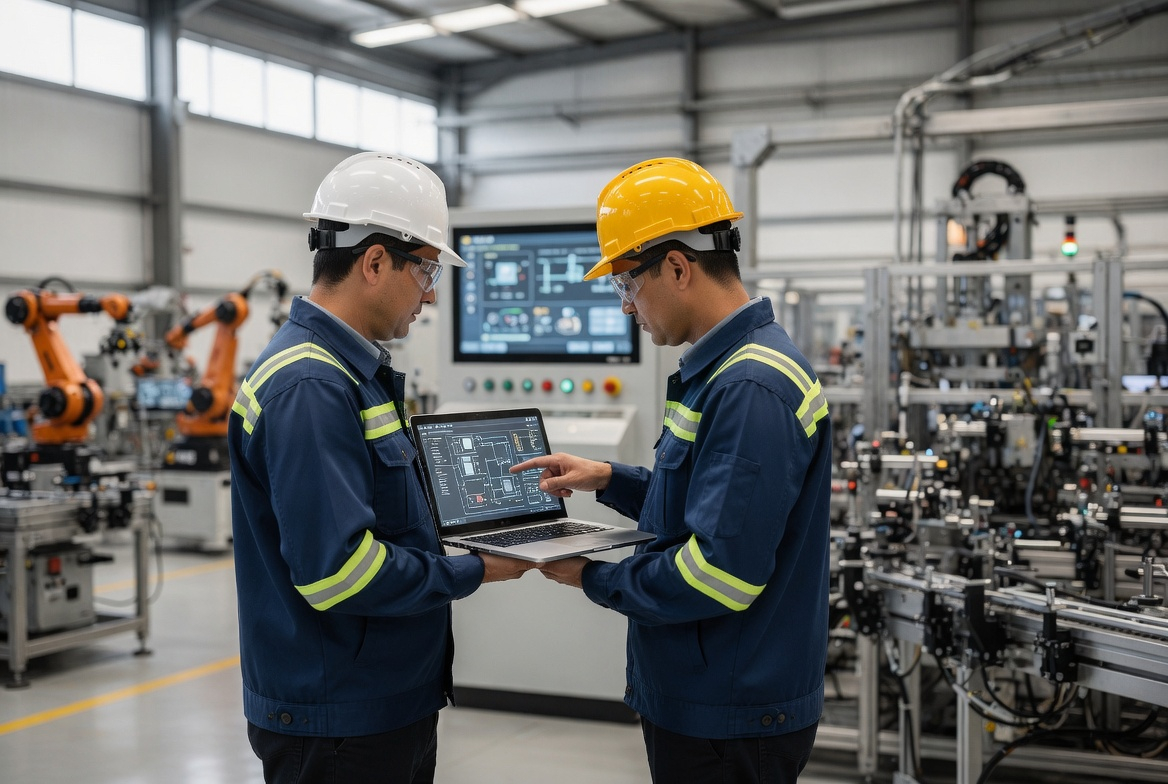
The industrial sector is defined by strict tolerances, high output demands, and absolute reliance on continuous operational uptime. Across manufacturing floors, processing plants, and critical infrastructure facilities, the margin for error remains incredibly slim. Machinery and equipment must operate within tightly defined parameters to meet production schedules and maintain commercial viability. Any interruption to these processes introduces significant financial and operational consequences. Unplanned downtime represents one of the most critical challenges facing engineering managers and plant operators today. It directly impacts profitability, disrupts supply chains, and can damage long-standing commercial relationships.
To address these vulnerabilities, modern industrial engineering increasingly incorporates sophisticated digital solutions designed to anticipate and resolve issues before they escalate into catastrophic failures. Central to this strategy is the implementation of remote monitoring technologies. These systems provide continuous, real-time visibility into machine performance, allowing engineering teams to diagnose faults, adjust parameters, and execute maintenance protocols without requiring a physical presence on the factory floor. Among the leading solutions in this domain is EWON, a highly specialised technology that provides secure, industrial-grade remote access to control systems.
By integrating EWON solutions into bespoke control panel design, MASK Control Systems delivers exceptional reliability and oversight for complex industrial applications. This technical analysis will explore the specific mechanisms through which remote monitoring mitigates unplanned downtime, the technical integration of EWON routers with existing automation infrastructure, and the measurable benefits of adopting a proactive, data-driven approach to industrial maintenance.
The Financial and Operational Impact of Unplanned Downtime
Before examining the technical solutions, it is necessary to quantify the problem. Unplanned downtime is not merely a temporary inconvenience; it is a systemic failure that cascades through an entire operation. When a critical component, such as a primary drive motor or a programmable logic controller (PLC), fails unexpectedly, the immediate result is a halt in production. However, the true cost extends far beyond the direct loss of manufactured goods.
Firstly, there are the direct labour costs. Production staff remain idle while waiting for the issue to be resolved, yet their wages must still be paid. Simultaneously, emergency maintenance teams are deployed, often requiring overtime rates or expensive call-out fees for external specialists. If the required replacement parts are not held in local inventory, expedited shipping costs add further financial strain.
Secondly, the operational disruption can cause secondary damage. For example, in continuous processing industries such as chemical manufacturing or food production, a sudden stoppage can result in the spoiling of entirely processed batches, leading to significant material waste. The equipment itself may suffer subsequent damage if a process halts incorrectly or abruptly.
Thirdly, the commercial implications can be severe. Missed delivery deadlines can result in contractual penalties, damage to reputation, and the potential loss of future business. For high-profile organisations and institutions requiring absolute reliability, such as Alstom, Babcock, and the UK MOD, the operational readiness of their infrastructure is non-negotiable. An unexpected failure in critical systems can have national or international implications.
The traditional reactive maintenance model, where action is only taken after a failure occurs, is inherently flawed in this high-stakes environment. Relying on scheduled preventative maintenance, while better, still leaves equipment vulnerable to unforeseen anomalies that develop between inspection intervals. The optimal approach requires continuous oversight and the ability to intervene immediately at the first sign of deviation from normal operating parameters. This is precisely the capability provided by advanced remote monitoring.
Engineering Remote Visibility with EWON
EWON is a specialised industrial VPN router designed specifically to facilitate secure, remote access to automation equipment. Unlike standard commercial networking hardware, EWON devices are engineered to withstand the rigorous conditions of industrial environments, including temperature fluctuations, electromagnetic interference, and physical vibration. They act as a secure bridge between the factory floor network and external engineering personnel, enabling remote diagnostics, programming, and system management.
The architecture of an EWON-enabled system typically involves installing the router within the main electrical control panel. The device interfaces directly with the central PLC, Human-Machine Interface (HMI), and other critical network components via Ethernet or serial connections. Once configured, the EWON router establishes a secure outbound connection to a cloud-based industrial VPN service, such as Talk2M. This outbound connection strategy is critical because it eliminates the need to open inbound ports on the facility's corporate firewall, thereby maintaining strict IT security protocols.
When an engineer requires access to the system, they authenticate through the secure VPN client on their local workstation. The VPN service then creates a secure, encrypted tunnel connecting the engineer directly to the specific EWON router, and by extension, the connected automation equipment. To the engineer's diagnostic software, the remote connection appears entirely transparent, exactly as if their laptop was physically plugged into the control panel via a local switch.
This capability fundamentally alters the maintenance workflow. Upon receiving an automated alert indicating a potential issue, an engineer can establish a connection within minutes, regardless of their physical location. They can interrogate the PLC logic, monitor real-time sensor data, review fault logs on the HMI, and force specific variables to test component responses. Often, software-related issues or incorrect parameter settings can be resolved immediately without a site visit. If a physical component has failed, the remote diagnostic process identifies the exact part required, ensuring that the dispatched field technician arrives fully equipped to resolve the issue on their first visit.
Integration with Leading PLC and SCADA Infrastructure
The effectiveness of any remote monitoring solution is entirely dependent on its compatibility with the existing automation architecture. Industrial environments rarely feature homogenous equipment from a single vendor. Instead, they typically consist of a complex mix of PLCs, variable speed drives, sensors, and SCADA (Supervisory Control and Data Acquisition) systems from various manufacturers.
EWON routers are highly versatile and support a wide array of industrial communication protocols, including Modbus TCP, Profinet, EtherNet/IP, and OPC UA. This extensive compatibility ensures seamless integration with hardware from the industry's most prominent manufacturers.
Siemens Integration
Siemens PLCs, particularly the S7-1200 and S7-1500 series, are ubiquitous in high-performance automation. Integrating an EWON router with a Siemens architecture allows remote engineers to utilise the TIA Portal software to monitor logic blocks, execute online edits, and diagnose hardware faults on remote Profinet networks. The high bandwidth capability of modern EWON devices ensures that large TIA Portal projects load efficiently, facilitating rapid troubleshooting of complex automation sequences. The remote accessibility provided by EWON significantly reduces the burden on on-site maintenance teams when dealing with sophisticated Siemens implementations.
Mitsubishi and Unitronics Systems
For systems relying on Mitsubishi hardware, such as the MELSEC iQ-R or FX5U series, EWON provides immediate access for GX Works3 programming software. Engineers can monitor specific registers, trace signal states, and identify logic errors that may be causing intermittent machine stoppages. Similarly, Unitronics systems, known for their integrated PLC and HMI architecture, can be fully accessed remotely. This allows support teams to update HMI graphics, modify control algorithms, and extract historical data logs to identify long-term performance degradation. The ability to manage these complex, all-in-one architectures remotely ensures that plant operators experience minimum disruption.
Allen Bradley Environments
In facilities utilising Allen Bradley ControlLogix or CompactLogix systems, EWON provides secure routing for Studio 5000 Logix Designer. The ability to remotely monitor tag values and execute trend analysis on an Allen Bradley system is critical for identifying subtle mechanical wear or process deviations before they cause a hard failure. The detailed diagnostics available through this software suite are fully supported by the high-speed data transmission capabilities of the EWON hardware.
Beyond individual PLCs, EWON acts as a critical enabler for remote SCADA systems. By facilitating continuous data aggregation from remote sites, EWON allows centralised SCADA platforms to provide a comprehensive overview of distributed assets. This is particularly valuable for large-scale operations across multiple facilities, enabling a single control room to monitor overall equipment effectiveness (OEE) and coordinate predictive maintenance schedules based on real-time empirical data rather than theoretical estimations.
The Anatomy of a Modern Industrial Control Panel
To fully appreciate the role of remote monitoring, it is beneficial to understand the physical environment in which these systems operate. The industrial control panel is the central nervous system of any automated process. It houses the intricate network of components that convert electrical power and programming logic into physical motion and process control.
A professionally engineered control panel begins with the physical enclosure, typically constructed from mild steel or stainless steel, rated to IP54, IP65, or higher to protect against dust and water ingress. Inside, the components are meticulously arranged on a galvanised backplate. Power enters through a primary isolator switch, followed by distribution blocks and a hierarchical arrangement of circuit breakers (MCBs) and motor protection circuit breakers (MPCBs) to safeguard against overcurrent and short circuits.
The control voltage, often stepped down to 24V DC via an industrial power supply, feeds the central intelligence: the PLC. The PLC is surrounded by input/output (I/O) modules, relays, and contactors. When the PLC logic dictates that a motor should run, it sends a low-voltage signal to a relay, which in turn energises the coil of a large contactor, allowing high-voltage three-phase power to reach the motor. For more precise control, variable frequency drives (VFDs) are employed to alter the speed and torque of the connected motors dynamically.
It is within this dense arrangement of high-voltage distribution and low-voltage control circuitry that the EWON router is installed. The device requires a dedicated 24V DC power feed and physical Ethernet connections to the PLC, the local HMI panel, and potentially the facility's local area network switch for outbound internet access. The physical installation must adhere to strict wiring standards, ensuring that communication cables are separated from high-voltage power lines to prevent electromagnetic interference. Properly segregating these cables is a core principle of quality control panel design, ensuring that the sensitive digital signals transmitted by the EWON router are not corrupted by the high currents flowing to the heavy machinery.
Detailed Walkthrough: A Remote Troubleshooting Scenario
To illustrate the practical value of this technology, consider a hypothetical, yet common, industrial scenario. A packaging facility operates a high-speed bottling line. At 2:00 AM, the line abruptly halts. The local operator reviews the HMI, which displays a generic "Infeed Jam" error. The operator clears the physical jam and attempts to restart the line, but the system refuses to initiate the sequence.
Under a traditional maintenance model, the operator would call the night-shift maintenance technician. The technician would arrive 30 minutes later, connect their laptop to the PLC, and begin tracing the logic. If the technician is unfamiliar with the specific machine, or if the fault is complex, this process could take several hours. If external support from the machine builder is required, the facility might wait until the following morning for an engineer to arrive on-site, resulting in eight to ten hours of lost production.
With an EWON remote monitoring system installed, the sequence changes dramatically. When the operator fails to restart the line, they contact the remote support team. Within five minutes, a senior automation engineer, working from a different city or country, securely authenticates into the Talk2M portal and connects to the facility's EWON router.
The remote engineer opens the PLC programming software, connects to the processor, and goes online. They navigate directly to the specific logic block governing the infeed conveyor. By monitoring the live variables, they quickly identify that while the physical jam has been cleared, a specific optical sensor on the line is still registering a "blocked" signal.
The engineer instructs the local operator to physically inspect that exact sensor. The operator discovers that the sensor lens is covered in dirt and packaging dust. The operator cleans the lens, the sensor state changes in the PLC logic, and the machine is immediately restarted. The entire diagnostic and resolution process takes less than twenty minutes. Production resumes, and the potential loss of a full night's manufacturing is averted. The speed and precision of this remote intervention demonstrate the profound operational advantages of continuous, secure access.
Implementing Rigorous Security Protocols
The introduction of external connectivity to critical industrial infrastructure inherently introduces cybersecurity considerations. Malicious actors increasingly target industrial control systems, and securing remote access pathways is an absolute necessity. The design philosophy of EWON prioritises security at every layer of the architecture.
As previously mentioned, the outbound connection strategy ensures that the facility's local area network remains hidden from the public internet. The VPN tunnels utilise advanced encryption standards (AES-256) and SSL/TLS protocols to secure all data in transit, preventing interception or tampering.
Furthermore, access to the system is strictly controlled through multi-factor authentication (MFA) and granular user access rights. Engineering managers can define exactly which users have permission to connect to specific machines, and they can restrict access to specific times or specific tasks. Comprehensive audit logs record all connection activity, providing complete traceability of who accessed the system, when the connection occurred, and the duration of the session.
For highly sensitive environments, physical security measures can also be integrated into the control panel design. This can include physical key switches that must be manually activated by on-site personnel before the remote connection can be established, ensuring that remote interventions only occur with the explicit knowledge and consent of local operators. MASK Control Systems ensures that all remote access implementations comply with stringent security standards, a commitment reflected in our adherence to ISO 9001, ISO 17020, and ISO 17025 certifications, guaranteeing the highest levels of quality and technical competence.
Analysing the Maintenance Paradigm Shift
To clearly understand the operational improvements provided by remote monitoring, it is helpful to contrast the traditional reactive maintenance sequence with the proactive, remote-enabled sequence.
A Comparison of Maintenance Workflows
| Phase | Traditional Reactive Maintenance | EWON Remote Monitoring Approach |
|---|---|---|
| Detection | Operator notices the machine has stopped or is producing out-of-tolerance parts. | Automated system alerts the engineering team to a parameter deviation before failure occurs. |
| Initial Response | Local operator attempts basic troubleshooting; escalates to local maintenance staff. | Remote engineer instantly connects to the PLC and HMI to review live data and fault codes. |
| Diagnosis | Maintenance staff travel to the machine, open the panel, and begin manual fault-finding. | Remote engineer identifies the exact sensor failure or logic error within minutes from their workstation. |
| Resolution | If external support is needed, a technician is scheduled, travel time is incurred, and the correct parts must be sourced. | Software issues are fixed instantly. If hardware has failed, the exact part is identified, and a technician is dispatched immediately with the correct spares. |
| Downtime Duration | Hours to days, depending on technician availability and spare parts inventory. | Minutes to hours; software issues resolved immediately, physical repairs executed on the first visit. |
This structural shift from reactive to proactive maintenance directly translates to increased operational availability. The reduction in diagnostic time alone often justifies the capital expenditure required to install remote monitoring hardware.
Strategic Applications Across Diverse Industries
The application of secure remote monitoring extends across numerous demanding environments. The technical requirements vary, but the fundamental need for reliability remains constant. MASK Control Systems has extensive experience implementing these solutions for a wide range of distinguished clients.
Critical Infrastructure and Defence
Organisations operating critical infrastructure require absolute certainty in their operational systems. For clients such as the UK MOD, the ability to monitor remote installations securely and reliably is essential for maintaining strategic readiness. EWON routers facilitate this oversight while adhering to the rigorous security protocols mandated by defence operations. Similarly, in the aviation sector, supporting the operational infrastructure for entities like Emirates and Etihad necessitates high-availability control systems. Remote monitoring allows for the continuous assessment of baggage handling systems, environmental controls, and fuelling infrastructure, ensuring seamless operations in highly time-sensitive environments.
Advanced Research and Development
In the academic and research sectors, the precision of environmental and process controls is paramount. Universities conducting advanced research, including the University of Exeter, the University of Southampton, and the University of Warwick, operate complex experimental rigs and climate-controlled facilities. The data integrity and operational stability of these systems are critical to the validity of their research. Integrating EWON technology into their HMI programming and control systems provides researchers and facility managers with continuous oversight, allowing them to monitor critical parameters remotely and intervene promptly to protect valuable experiments from equipment failures.
Heavy Engineering and Manufacturing
In heavy engineering and transportation sectors, supporting clients such as Alstom and Babcock, the scale and complexity of the machinery demand highly sophisticated diagnostics. Large manufacturing processes, robotic assembly lines, and heavy lifting equipment are heavily reliant on intricate PLC logic and networked drives. When a fault occurs on a large production line, identifying the root cause can be exceptionally difficult due to the sheer volume of interconnected components. Remote monitoring provides the necessary overarching visibility. Engineers can trace faults through the network topology, monitor drive currents, and analyse the sequential logic to pinpoint the specific point of failure, vastly reducing the time required to restore full production capacity.
Predictive Maintenance Algorithms and Data Handling
Beyond immediate fault resolution, the continuous data stream provided by remote monitoring facilitates long-term operational improvements. Modern EWON hardware features significant internal memory and processing capabilities, allowing it to act as an edge computing device. It can gather high-frequency data from the PLC, process the data locally, and transmit aggregated metrics to a central database or cloud platform.
This capability is the foundation of predictive maintenance. By aggregating historical performance data, engineering teams can identify subtle trends that indicate impending mechanical wear or process degradation. For example, a gradual increase in the current draw of a specific motor, while still within operational limits, may indicate bearing wear or increased mechanical friction in the driven load. Similarly, monitoring the response time of pneumatic cylinders can reveal deteriorating seals before they fail completely.
Recognising these trends allows maintenance teams to schedule a component replacement during a planned shutdown period, rather than waiting for the part to fail catastrophically during peak production. This data-driven approach shifts the maintenance focus from reacting to breakdowns to proactively managing the physical assets based on actual empirical data. Furthermore, analysing historical data can reveal opportunities for process optimisation. By reviewing the performance metrics of identical machines operating across different sites or shifts, engineers can identify the optimal operating parameters and standardise these settings across the entire operation. This continuous refinement leads to increased throughput, reduced energy consumption, and extended equipment lifespans.
Final Thoughts on Industrial Connectivity
The modern industrial environment leaves no room for the inefficiencies associated with unplanned downtime. The financial penalties and operational disruptions are simply too severe. Securing the continuous operation of critical machinery requires a shift away from traditional reactive maintenance towards a proactive, data-driven methodology.
Implementing EWON remote monitoring solutions, integrated within professionally engineered control panels, provides the necessary infrastructure to achieve this goal. By enabling secure, immediate remote access to PLCs, HMIs, and SCADA networks, organisations can drastically reduce diagnostic times, increase first-time fix rates, and shift towards predictive maintenance strategies. MASK Control Systems remains committed to delivering these advanced engineering solutions, drawing upon our extensive experience with industry-leading hardware and our adherence to the highest standards of quality and security. The integration of remote monitoring is an essential technical requirement for maintaining maximum availability and operational efficiency in the contemporary industrial sector.